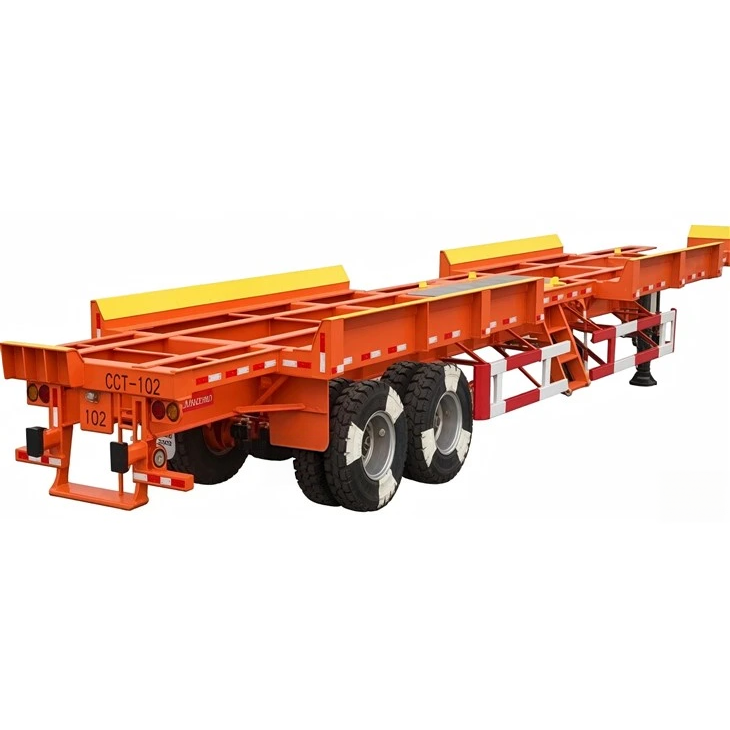


A full trailer typically consists of a frame, body, towing mechanism, steering mechanism, suspension, running gear, braking system, signaling system, and other components. In a straight-beam frame design, the upper flanges of the longitudinal beams are entirely flat. The advantages of this design include a level cargo deck floor, a simple manufacturing process, generally high ground clearance, and excellent longitudinal passability. To meet specific structural and operational requirements, the frame of a heavy-duty flatbed full trailer is primarily composed of main beams, crossbeams, support beams, and side beams. The total vehicle load is transmitted to the ground via the support beams (situated between the crossbeams), the suspension system, the wheel axles, and the wheels. The main beams, support beams, and side beams of the frame are welded components featuring a box-section profile, which endows them with significant torsional rigidity. The crossbeams connecting the main beams extend outward to both sides; these feature a variable-section, welded I-beam structure, providing high lateral bending strength. The main beams of the frame are relatively deep in vertical dimension and extend downward; this design enhances the frame's longitudinal bending strength without increasing the overall height of the cargo deck. Beneath each support beam, a turntable mechanism is installed to accommodate the balanced suspension system, thereby enabling all-wheel steering.
Heavy-duty full trailers are designed to transport cargo of substantial mass and large physical dimensions; consequently, it is generally necessary to increase the structural strength of the frame while simultaneously minimizing its overall height to facilitate efficient cargo loading, unloading, and transportation. Based on the structural configuration of their longitudinal beams, full trailer frames are classified into three types: straight-through frames, step frames, and drop-beam frames.