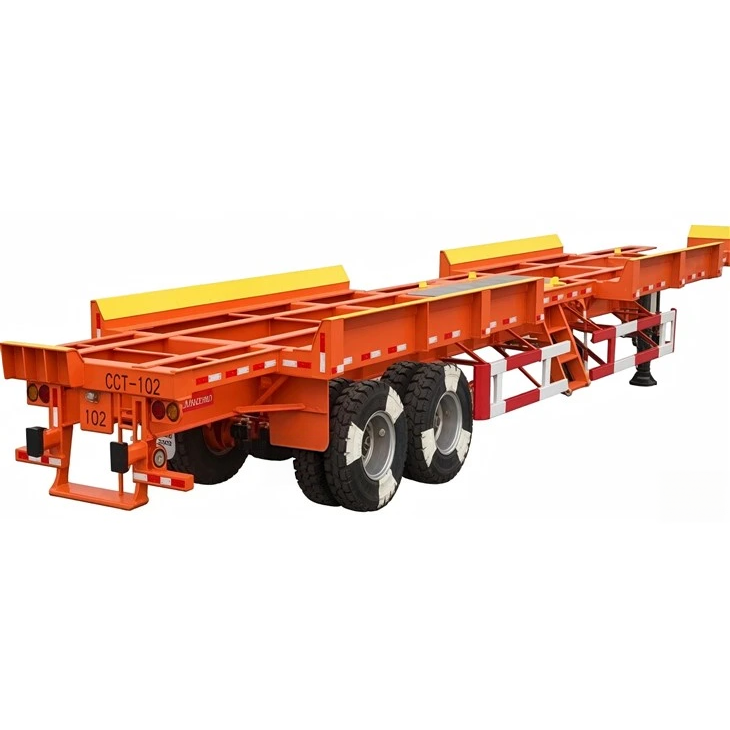


Detachable gooseneck lowboy trailers offer superior loading and unloading efficiency. Their design-optimized through modular construction, low-deck characteristics, and advanced hydraulic/pneumatic systems-significantly enhances the ease and safety of handling heavy cargo. These advantages are specifically manifested in the following aspects:
Modular Design Enhances Flexibility
Detachable Gooseneck Structure
The gooseneck section connects to the front of the semi-trailer via hydraulic or mechanical locking mechanisms. Detachment requires no complex tools; the tractor unit can simply pull the gooseneck away from the trailer directly. For instance, when transporting oversized cargo such as wind turbine tower sections, detaching the gooseneck allows the trailer bed to extend beyond 20 meters, preventing the cargo from overhanging the vehicle's boundaries. Conversely, when transporting standard cargo, attaching the gooseneck lowers the trailer's overall height, thereby enhancing driving stability.
Case Study: Goldhofer Group (Germany) offers detachable gooseneck lowboy trailers that allow for flexible adjustment of the trailer bed length by detaching the gooseneck. Using this system, the company successfully transported an 85-meter wind turbine tower section, reducing loading/unloading time by 62.5% and lowering the cost per single shipment by 30%.
Telescopic Deck Design
The cargo deck features a "#"-shaped telescopic structure; it can be extended when transporting oversized cargo and retracted when transporting standard cargo to improve maneuverability. For example, when transporting extra-long steel beams, a telescopic deck reduces the number of required trips and optimizes cargo space utilization.
Low-Deck Design Simplifies Loading and Unloading
Low Deck Height
The cargo deck typically sits below 1.2 meters in height, allowing heavy equipment (such as excavators and bulldozers) to be driven directly onto the deck without the need for auxiliary lifting equipment. For instance, on fixed-gooseneck lowboy trailers used for transporting mining machinery, the inclusion of a rear-access ramp design boosts loading/unloading efficiency by 80% and increases the single-trip turnover rate by 30%.
"Double-Drop" Deck Design
Both the gooseneck section and the rear wheel wells feature a lowered profile. This design further reduces the overall deck height, resulting in a lower center of gravity for the cargo and significantly enhancing transport stability. For example, telescopic lowboy trailers utilizing this "double-drop" design lower the cargo's center of gravity by 30%, thereby reducing the risk of rollover during sharp turns by 50%.
Hydraulic and Pneumatic Systems: Optimizing Loading and Unloading Processes
Hydraulic Loading Decks
Loading decks equipped with hydraulic systems feature adjustable heights to match various loading platforms (such as warehouse docks or construction site pits), thereby reducing the need for ramps or ladders. For instance, hydraulic gooseneck lowboy trailers utilize hydraulic cylinders to raise and shift the gooseneck-facilitating its detachment-while simultaneously enabling the front-end loading of heavy equipment, a method generally safer than rear-end loading.
Air Suspension Systems
These systems harness the compressed air from the tractor unit's braking system to power the detachment of the gooseneck; they are lightweight and demonstrate high reliability in low-temperature environments. For example, on air-detachable gooseneck trailers, the air springs (airbags) cushion the cargo during transport to absorb shocks; concurrently, an air pressure gauge monitors the load in real-time, triggering an automatic alarm in the event of an overload to prevent cargo damage.
Specialized Loading and Unloading Auxiliary Designs
Front-End Ladders and Ramps
Ladders are integrated into the gooseneck section to form a low-angle ramp relative to the ground, enabling self-propelled heavy equipment (such as excavators) to drive directly onto and off the loading deck. For instance, the front-end ladders on Removable Gooseneck (RGN) lowboy trailers can establish a rigid structural support against the ground, allowing heavy machinery to drive itself onto the trailer, thereby making the loading and unloading process faster and safer.
Anti-Slip and Securing Devices
The surfaces of the loading decks are fitted with anti-slip steel plates or rubber mats to enhance friction. Additionally, they are equipped with securing devices-such as chains, tie-down straps, and anti-slip chocks-to ensure the cargo remains stable and secure. For example, when transporting precision instruments, the combined use of anti-slip chocks and tie-down straps can reduce cargo displacement from 5% to 0.2%, thereby cutting transport-related losses by 90%.